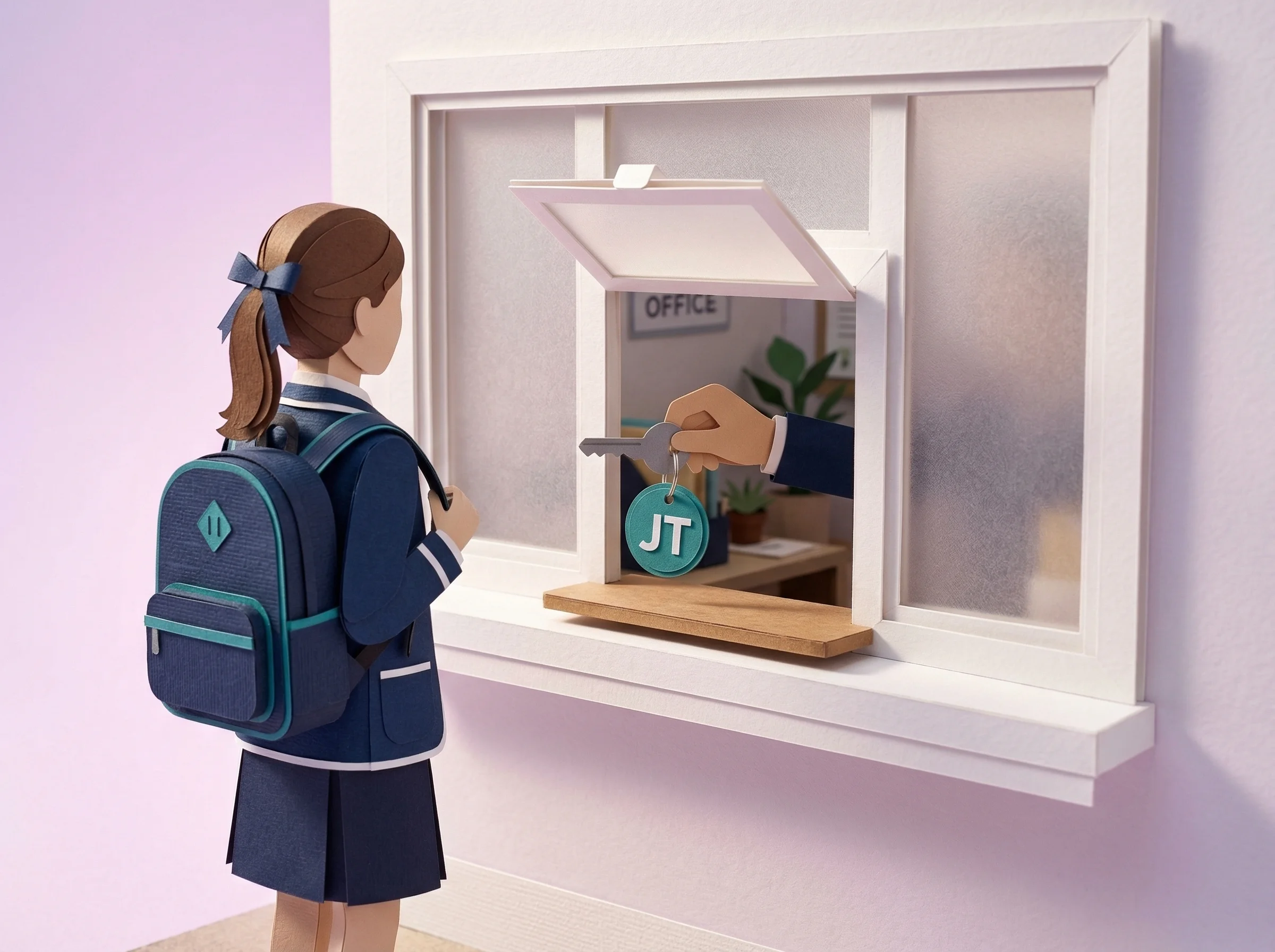
Vero starts with a simple idea: replace paper sign-out sheets with a teacher-created digital pass and a shared open-pass register. The same platform also includes modules and reports for other day-to-day school workflows.
Here are ten capabilities a school can evaluate against its own routines during a one-term pilot.
1. Replacing paper sign-out sheets
This is where it starts. Every school has some version of the paper sign-out system: a clipboard by the door, a ruled exercise book on the teacher's desk, a photocopied sheet with columns for name, time, and destination. They are familiar, free, and almost entirely useless for anything beyond the individual classroom.
With Vero, the teacher selects the student and destination to create a digital pass. Associated times are recorded, the teacher closes the pass on return and authorised roles can search the history under the school's retention settings.
Vero is designed for a pass to be created in two taps and under five seconds. Compare that workflow with your current process during the pilot, then review the difference for teachers and authorised staff. See a full comparison of digital passes vs paper sign-out sheets.
2. Reviewing late-to-class patterns
A student arrives to class three minutes after the bell. The teacher marks them late in the roll. That data point lives in the school's student information system — Compass, SEQTA, Sentral, or TASS — but it tells you nothing about why the student was late or where they were coming from.
With Vero, the picture fills in. If that student was signed out from their previous class on a digital pass and the pass shows they did not return for twelve minutes, the late arrival is not a mystery. It is the end of an extended out-of-class trip that started a period ago. The data connects the dots.
Deputy principals and year coordinators can use the record to add context to late-to-class patterns. Rather than treating the number as a conclusion, staff can ask what was happening before the late arrival. See more on how Vero supports late-to-class follow-up.
3. Managing student separation
Every school has students who need to be kept apart. Conflict, bullying history, AVO conditions, or wellbeing concerns — the reasons vary, but the requirement is the same: these students should not be in the same unsupervised space at the same time.
Managing this with paper sign-outs is essentially impossible. A teacher in one building has no way of knowing that a student they just signed out to the bathroom is about to overlap with another student — signed out from a different classroom in a different building — who they are supposed to be separated from.
Vero's Smart Separation checks staff-defined groups at pass creation. If another member has an active pass, the teacher sees a warning and can wait or use a logged override. It supports professional judgement rather than replacing it.
4. Emergency lockdown visibility
During a lockdown, staff follow the school's emergency plan and account for students using its approved roll and headcount process. Classroom paper sheets may be inaccessible to central staff, while a shared active-pass list can add operational context.
Vero can show authorised staff which students have active passes, the class associated with the pass, the selected destination and the recorded time. It does not show a student's physical location, and usefulness still depends on adoption, connectivity and the school's procedures.
In an emergency lockdown, Vero can show authorised staff the students with active passes and their recorded destinations. That list supports, but does not replace, the school's roll, headcount and emergency procedures.
5. Counsellor wellbeing referrals
Wellbeing teams can review changed pass-record patterns alongside referrals, attendance, teacher observations and student voice. The data does not diagnose distress or replace a referral process.
A student who leaves class four times a day, every day, for two weeks straight is sending a signal. They may be experiencing anxiety. They may be avoiding a peer conflict. They may be struggling with the content and using bathroom breaks as an escape valve. Without data, that pattern is invisible — it looks like occasional bathroom visits spread across different teachers and different periods.
Authorised wellbeing staff can review pass-record patterns that may deserve a conversation. Frequent records, extended recorded durations or repeated requests are context, not a diagnosis; professional judgement and the student's circumstances remain central.
6. Duty of care audit trails
Australian schools operate under clear duty of care obligations. When a student is injured or involved in an incident outside the classroom, the question is not just "What happened?" It is: "What systems did the school have in place to manage student movement, and were they being used?"
Paper sign-out sheets can be difficult to aggregate across a school. A digital pass creates a searchable, timestamped record of teacher-created passes, subject to the school's retention and access settings.
A timestamped record can help a school establish what its process recorded during a parent complaint or internal review. It supports — but does not by itself prove — compliance. See the relevant context for New South Wales, Victoria and Queensland.
7. Reducing bathroom vandalism
Bathroom vandalism can create repair costs, closed facilities and staff follow-up. Schools should establish the scale from their own maintenance and incident records.
After an incident, authorised staff can search for teacher-created passes to the recorded destination during the relevant window. The result supports a wider review; it does not show who entered the bathroom or justify a suspect list.
The record does not prove who caused damage. It can, however, give authorised staff a clearer place to begin by showing which students had recorded passes to the destination in the relevant time window.
8. Parent communication
Pass records can give a parent meeting specific context such as dates, recorded durations and selected destinations. They remain one source to discuss alongside the student's account, known adjustments and other relevant information.
"Jake left class fourteen times this fortnight, averaging sixteen minutes per trip. Eleven of those trips were to the same bathroom block during Period 4." That is a different conversation from "We're concerned about Jake's time out of class." Parents are more likely to take the discussion seriously — and work collaboratively with the school — when the evidence is clear and documented.
A timestamped record can also help a school answer questions about an incident clearly. It gives staff and families a shared chronology to review together, alongside the student's circumstances and any other relevant information.
9. Uniform tracking
Vero includes a dedicated Uniform module. Staff can record a uniform item or category in two taps, separate from the out-of-class pass workflow.
Over time, this creates a dataset that most schools have never had: which students are consistently out of uniform, on which days, and whether the non-compliance correlates with other patterns. Year coordinators can follow up with specific students based on data rather than memory. Parent letters about uniform can reference exact dates and frequencies. It is a small addition to the digital pass workflow, but it fills a gap that schools have been managing with nothing more than anecdotal teacher reports for decades.
10. Values-in-action recognition
Not every school workflow should centre on problems. Vero's separate Values in Action module lets staff record positive contributions against the school's own values.
The module is designed for intentional recognition: a teacher selects a student, chooses the relevant school value and adds context if useful. Movement records should not be treated as an automatic score of a student's character.
Because the school defines its own values, recognition can reflect the language already used in assemblies, pastoral programs and classrooms.
Keeping positive recognition visible alongside operational records creates a more balanced picture of the school day.
What started as a pass became a platform
Start with the workflow your school intends to improve. During a one-term pilot, evaluate the relevant Vero modules against agreed questions rather than assume use cases or outcomes will expand.
The modules give different authorised roles a shared record to review in context: a wellbeing team may notice a change worth discussing; a deputy principal can retrieve relevant pass records during an incident review; emergency staff can consult the active-pass list alongside the approved headcount process; and a teacher can discuss an extended pass with a student. None of those records supplies a diagnosis, physical location or finding of misconduct.
Schools may begin with paper replacement or another operational need. See pricing or book a 20-minute walkthrough to decide which capabilities are relevant to your pilot.