The noise that nobody scheduled
During class time, corridors should support a settled learning environment. The actual level of disruption varies by campus and period, so begin with the school's own baseline.
Raised voices near a bathroom block or students gathering outside the library can interrupt nearby lessons. A shared record helps the school test when disruption and active-pass volume overlap.
One response is additional supervision: duty teachers, corridor patrols and revised rosters. Another is to understand why students have teacher-created passes and where recorded overlaps occur. The right mix depends on the school's layout, risks and staffing.
Why corridor disruption happens
Corridor congestion may reflect pass volume, campus layout, transition timing, facilities or coordinated social activity. Do not assume one cause before reviewing the context.
Loose record-keeping creates invisible volume
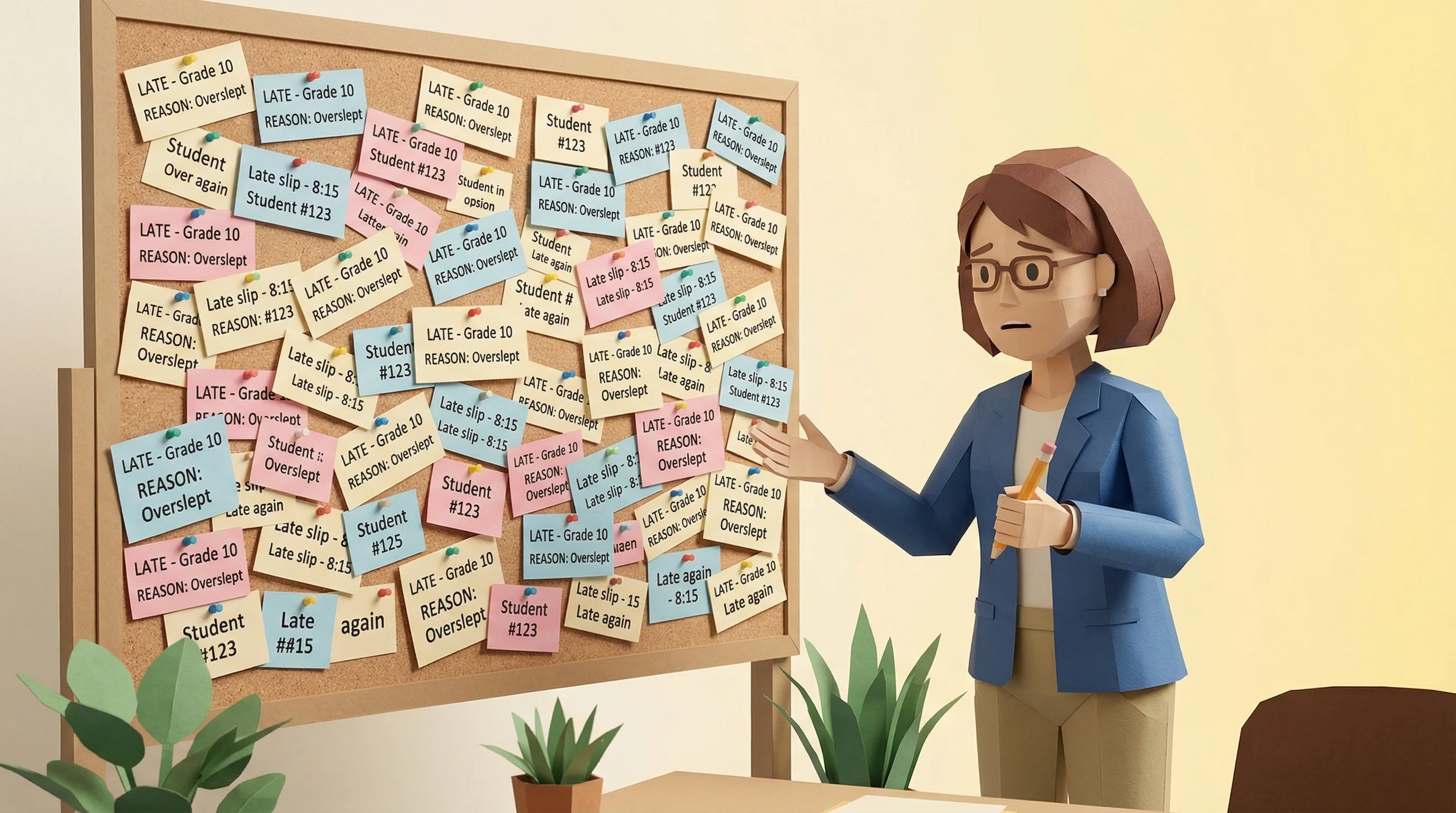
Where teachers manage requests independently, the school-wide picture may be dispersed across paper sheets, verbal approvals and lanyards. A shared pass system can give authorised staff one view of open records.
No accountability for duration
A student asks to use the bathroom and the teacher approves the request. A paper sheet may leave the teacher or central staff without a current shared record until the student returns. Schools should establish from their own baseline how often duration or missing return times create a problem.
Across many classrooms, separate pass decisions can create a larger flow through corridors that no single teacher can see.
Social coordination
Students from different classrooms may have overlapping passes. A shared record can make the overlap visible, but it does not show that students met or coordinated their exits.
Overlapping passes may be unrelated, or they may coincide with noise, socialising or an incident report. The pass record does not establish vaping, bullying or class avoidance; it is one input to review alongside other evidence.
Overlapping passes from different classrooms are a pattern worth reviewing, not proof that students met in a corridor.
Why extra supervision does not scale
Additional supervision can be appropriate, but corridor patrols during class time also have practical limits.
- Staffing constraints. Corridor supervision draws on the same finite staff time as teaching and other duties.
- Coverage gaps. Larger, multi-building campuses may be difficult to cover continuously.
- Reactive scope. A corridor patrol can respond to what staff see but may not reveal the broader pass pattern.
- Staff workload. Include any additional duty time in the evaluation.
Supervision has an important place. A pass record can supplement it by showing active-pass volume and recorded destinations across classrooms.
Why stricter rules do not work either
When supervision fails, the next instinct is restriction. Limit bathroom breaks to one per period. Lock bathrooms during certain times. Require students to collect a physical key from the front office. Ban all movement during the first and last ten minutes of every lesson.
These rules share a common problem: they require enforcement, and enforcement requires the very visibility that the school does not have.
A teacher in the middle of a lesson cannot simultaneously teach thirty students and verify whether a departing student has already used their one bathroom break this period. A "no movement in the first ten minutes" rule is only as strong as every teacher's willingness and ability to enforce it consistently — and consistency across thirty or forty classrooms is the one thing schools cannot guarantee without a shared system.
Worse, blanket restrictions punish every student equally. The student with a medical condition, the student who genuinely needs the bathroom, the student who is having a difficult day — they all face the same barriers as the students who are gaming the system. That generates resentment, parent complaints, and staff frustration, without actually solving the underlying problem.
How visibility changes the dynamic
Before adding supervision or rules, a school can establish a baseline for active-pass volume, recorded destinations and corridor incidents, then test a proportionate change.
When every classroom uses the same digital out-of-class pass system, the data aggregates automatically. For the first time, the school can answer the questions that matter:
- How many open pass records are there? A shared count for authorised staff to review against the school's process.
- Where are they going? Is the C-block bathroom seeing ten visits this period while the A-block bathroom has two? Now you know.
- How long are they taking? The average bathroom trip should be three to five minutes. Students averaging fifteen minutes are either struggling or using the time for something else. The data flags it automatically.
- Do pass windows overlap? Repeated timing overlaps can be reviewed in context; they do not prove coordination or an encounter.
The shared open-pass register uses the teacher-created workflow already being evaluated. Any effect on staffing or rules should be measured during the pilot.
The numbers speak for themselves
A school can test whether a digital out-of-class pass changes simultaneous pass volume during a one-term pilot. Possible mechanisms to evaluate include:
- Teachers make better decisions. When a teacher can see that five students are already signed out to the same area, they are more likely to ask a student to wait a few minutes. Not as a restriction — as an informed choice.
- Schools can test duration. Timestamped passes create a local baseline. Vero does not promise that awareness of the record will shorten a pass.
- Timing overlaps become visible. Overlapping pass windows can prompt a review, but they do not prove coordination or an encounter.
Use Behaviour Insights to compare corridor incidents, pass volume, duration and staff effort with the baseline. Vero does not guarantee a particular behaviour outcome.
From reactive to proactive: using the data
Visibility is the foundation, but the real value comes from what schools do with the data over time.
Identify your problem periods
If the school's data shows a peak around a period, day or recorded destination, leaders can test a targeted response rather than assuming disruption is evenly distributed.
Have specific conversations
When a deputy principal can sit down with a student and say, "Twelve pass records were created in this fortnight, and nine had a recorded duration over fifteen minutes," the conversation is more specific than "We have noticed you're spending a lot of time out of class." The record is a starting point for checking context, not proof that can be used to force a conclusion. Pass records turn vague concerns into more careful conversations.
Spot wellbeing signals
Not every student who leaves class frequently is causing disruption. Some are avoiding something — a difficult peer relationship, a subject they are struggling with, overwhelming anxiety. Frequent movement can be a wellbeing signal, but only if someone can see the pattern. Without data, the student who needs support looks the same as the student who is gaming the system. With data, the wellbeing team can intervene early.
Protect your duty of care position
Schools have duty-of-care and supervision responsibilities that vary by jurisdiction and circumstance. A timestamped pass record may support the school's review, but it does not prove that the system was reasonable or legally compliant.
What you can do this term
A practical starting point for corridor disruption is to measure the current pattern before choosing a response:
- Acknowledge the gap. If your school cannot answer the question "How many students are out of class right now?" you have a visibility problem, not a behaviour problem.
- Move from paper to digital. Paper sign-out sheets keep records trapped in individual classrooms. A digital out-of-class pass system brings teacher-created records into a shared register for authorised review.
- Test the effect. Compare pass volume, corridor incidents, student experience and staff effort with the baseline. Do not assume visibility alone will change behaviour.
- Use the summaries. Look for patterns. Identify peak times or high-volume destinations, then validate the context before speaking with any student.
- Support your staff. The goal is not to add another task to teachers' plates. Vero is designed for an under-five-second pass; use the pilot to evaluate the teacher workflow in context.
A shared record makes active passes visible. The school still needs to decide and evaluate the appropriate response.