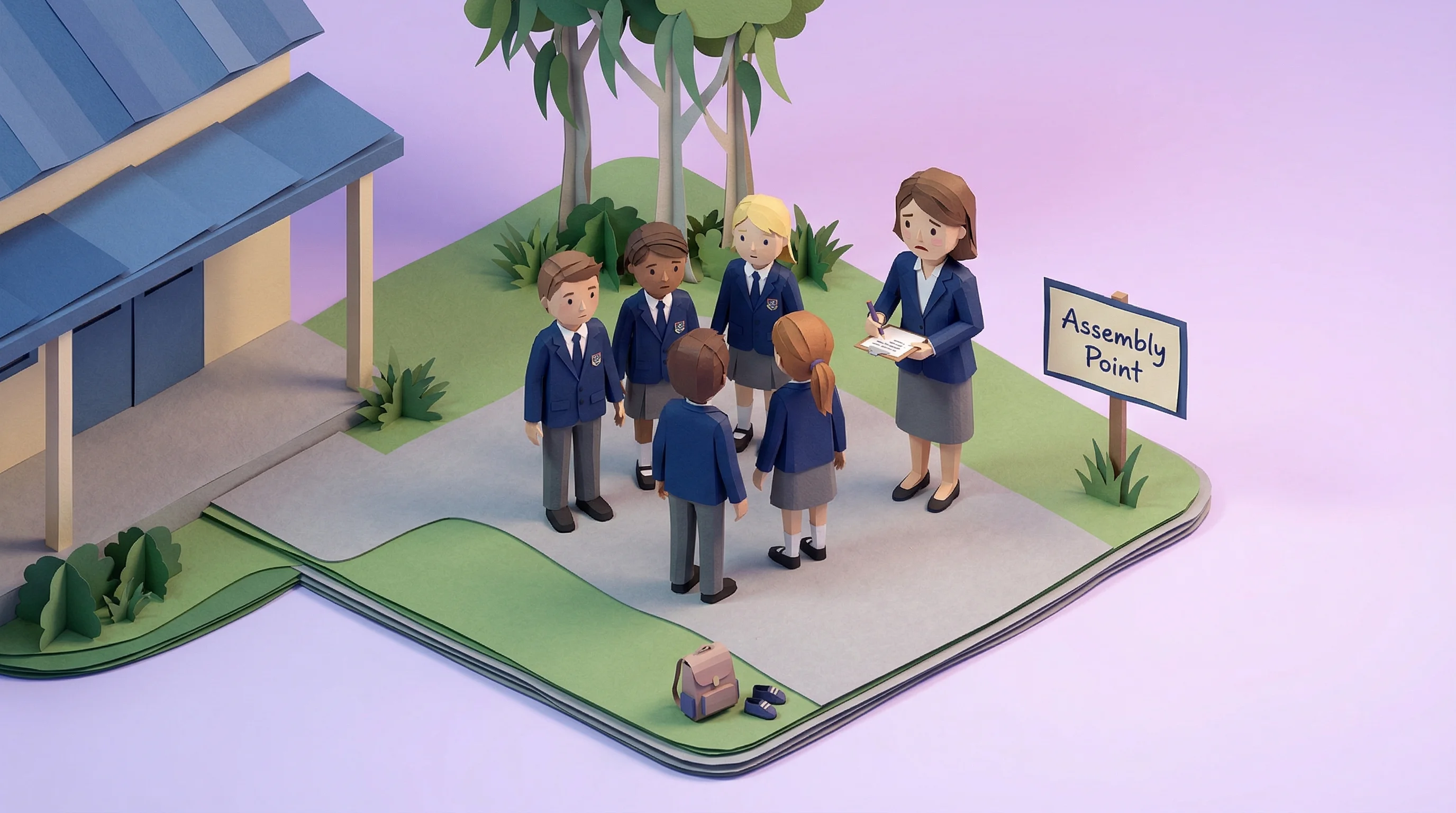
Every Australian secondary school has students who should not be in the same unsupervised space at the same time. The reasons vary — a bullying investigation, a physical altercation, a family dispute that has spilled into school life, or a formal no-contact order from the courts. Whatever the cause, the school's obligation is the same: take reasonable steps to keep them apart.
During class time, this is manageable. Timetabling can separate students into different classes, and teachers provide direct supervision. But out-of-class time — bathroom visits, trips to the front office, transitions between buildings — is where separation agreements fall apart. Two students from different classes, different year levels, different buildings can end up in the same bathroom block at the same time, and no one in the school knows it is happening until it is too late.
This article covers why student separation can be difficult during out-of-class time, questions for manual processes and how Vero's Smart Separation feature can put relevant active-pass context in front of a teacher.
Why separation is hardest during out-of-class time
School leaders spend significant effort on in-class separation. Timetables are adjusted. Students are placed in different form groups. Seating plans are communicated. But the moment a student steps outside the classroom, those controls evaporate.
Consider the reality of a typical secondary school with 800–1,200 students:
- Multiple students are out of class at any given moment. During a busy period, 10–20 students might be moving through the school simultaneously — from different classes, with different teachers, heading to different destinations.
- No single staff member has visibility across the whole school. The Year 8 English teacher who sends Student A to the bathroom has no idea that Student B's Year 8 Science teacher, three buildings away, sent Student B to the bathroom two minutes earlier.
- Paper sign-out sheets are classroom-level documents. They record who left a specific room. They cannot cross-reference across rooms, across year levels or across the school. The information exists in fragments that are difficult to assemble for an authorised review.
- Bathroom blocks are shared spaces. Unlike classrooms, bathrooms are not assigned by year level or class group. Any student with a pass can access any bathroom. This is the most common location for unwanted encounters between separated students.
The result is a review gap that exists by structural design, not by negligence. Schools are built for shared movement. Separation agreements work across classrooms, and a shared record can give authorised staff a defined advisory workflow when a relevant pass is created.
Legal and safeguarding context
Formal orders, safety plans, wellbeing arrangements and internal agreements can carry different obligations. Schools should obtain advice for the specific instrument and ensure any software configuration reflects, but does not replace, the authorised plan.
Schools have duty-of-care and safeguarding responsibilities that depend on jurisdiction and circumstances. A pass-overlap warning may support the process; it does not determine whether the school's measures were legally reasonable.
No pass system can guarantee that students never cross paths. Review staff responsibilities, relief-teacher access, overrides, escalation and the limitations of the recorded data with the school's advisers.
- A safety plan that exists only in a file is not a system. If the separation rule is documented in a student's welfare file but not operationalised in daily practice, it is a plan on paper, not a measure in action.
- Relying on individual teachers to remember is not reasonable. A school with 60 staff and a dozen active separation pairs cannot expect every teacher to hold every rule in their head. Staff turnover, casual teachers, and term-to-term changes make this impossible.
- Test cross-classroom awareness. Can the second teacher see the relevant active-pass context at the moment they create a pass?
Document the school's process, the authorised basis for the named group, who can view it, how overrides are handled and how the arrangement is reviewed. The required record depends on the school, sector and specific plan.
Common manual separation approaches
The following manual approaches are understandable, but each has a gap at the point a teacher is deciding whether to create a pass.
The email chain
A deputy principal sends an email to all staff: "Please be aware that Student A and Student B should not be out of class at the same time. If one is already out, please do not issue a pass to the other." This works on the day the email is sent. Within a fortnight, half the staff have forgotten. New casual teachers never received the email. And the deputy principal has no way of knowing whether the instruction is being followed.
The staffroom notice
A printed list of separation pairs is pinned to the staffroom noticeboard. Staff are expected to check it before issuing passes. In practice, no teacher walks to the staffroom to consult a list before letting a student go to the bathroom. The information is available, but it is not accessible at the point of decision.
The mental model
Year coordinators and wellbeing staff often carry separation rules in their heads. They intervene when they happen to see both students in the same area. A staff-defined advisory can put the approved context in front of the issuing teacher, while still requiring human judgement and avoiding claims about physical location.
The timetable workaround
Some schools try to solve the problem entirely through timetabling — ensuring separated students are never in adjacent rooms or never have classes in the same block. This helps during class time but does nothing for the 30–50 out-of-class movements that happen each day. A well-timetabled school can still have both students in the same bathroom block at 11:15am.
None of these approaches are unreasonable on their own. The problem is that none of them gives authorised staff a consistent cross-classroom record to review. They are point-in-time measures applied to a problem that spans multiple classrooms.
A scenario: two Year 8 students and a no-contact agreement
To make this concrete, consider a scenario that plays out in Australian schools more often than most leaders would like to admit.
Jordan and Kai are in Year 8. They were involved in a serious bullying incident last term. The school's wellbeing team documented a no-contact agreement. Timetabling placed them in different classes. Their year coordinator briefed all Year 8 teachers.
It is Tuesday, Period 3. Jordan's English teacher sends Jordan to the bathroom with a paper sign-out. Two minutes later, Kai's Science teacher — in a different building — sends Kai to the bathroom. Neither teacher knows the other student is out. Both students end up in the same bathroom block.
In this illustrative scenario, the two passes overlap. That does not prove the students encountered one another, but it shows why cross-classroom active-pass context may be useful.
Paper cannot cross-check an open pass in another classroom. A staff-defined advisory can put the approved separation context in front of the issuing teacher for a human decision.
If the arrangement is later reviewed, the school may need to explain its process and the information available to staff. What is sufficient is a matter for the school's policies and advisers.
How Smart Separation changes the equation
Smart Separation checks staff-defined named groups during pass creation. If another group member has an active pass, the teacher sees a warning and may wait or override with a logged reason.
Here is how it applies to Jordan and Kai's scenario:
- An administrator creates a separation rule in Vero linking Jordan and Kai. This takes 30 seconds and can be done by any admin with access — the deputy principal, the year coordinator, or the wellbeing leader.
- Jordan's English teacher creates a pass for Jordan to go to the bathroom. The pass is issued normally. Vero records it.
- Two minutes later, Kai's Science teacher goes to create a pass for Kai. Before the pass is confirmed, Vero checks whether another member of Kai's staff-defined group has an active pass.
- The teacher sees a clear alert that Jordan has an active pass. The teacher can wait or proceed with a logged override if they judge it appropriate. The alert does not show Jordan's physical location.
- The alert is logged. Whether or not the teacher proceeds, the separation event is recorded — creating an audit trail that shows the system flagged the conflict and a decision was made.
The critical difference is timing. The alert happens at the point of decision — the exact moment the teacher is about to create a pass. Not in an email sent last fortnight. Not on a noticeboard in the staffroom. Right there, right then, with the specific information the teacher needs.
What this means for compliance and audit
For an authorised school review, Smart Separation can provide:
- A documented group. The separation group is recorded in Vero and managed by authorised staff.
- A logged event. Alerts and override reasons are retained for authorised review.
- Context at the point of decision. The warning appears inside the pass workflow, where the teacher can wait or override.
The log can support a school's wider review of its process, but it does not prove legal compliance or show that an incident was prevented. Schools should apply their own safeguarding and legal requirements.
Beyond no-contact orders: other separation use cases
While formal no-contact agreements and AVOs/IVOs are the most legally significant use case, schools use Smart Separation across a range of scenarios:
- Post-incident cooling-off periods. After a fight or serious confrontation, schools often want a temporary separation for a week or two while the situation de-escalates. Smart Separation rules can be created and removed as needed.
- Bullying-response plans. Where the school's authorised plan includes separation, a warning can place active-pass context in front of the teacher.
- Peer influence management. Some students have a pattern of negative behaviour when together — vaping, vandalism, truancy. Separating them during out-of-class time disrupts the dynamic without requiring punitive measures.
- Sibling conflict. In schools where siblings are in different year levels, family tensions sometimes play out during out-of-class time. Separation rules can be applied as a pastoral care measure.
- Wellbeing plans. Where a plan specifies separation, Smart Separation can support its daily workflow without proving compliance.
The school's authorised team decides who belongs in a named group and why. Smart Separation provides a warning and logged override; it does not hard-block passes, guarantee separation or replace professional judgement.
From hope to system
The practical gap is getting relevant active-pass context to the second teacher at pass creation. A warning supports that moment while leaving the decision with the teacher.
Manual approaches served schools when there was no alternative. But the limitations are clear: they depend on memory, they are difficult to cross-reference and they produce no shared audit trail. For a problem where the stakes include student safety, legal liability and parent trust, those limitations are material.
If your school is managing student separations with email chains, staffroom notices, or hope, there is a better approach — one that works every time, for every teacher, without adding a single extra step to their day.
This article is for informational purposes only and does not constitute legal advice. Schools should consult with their legal advisors regarding specific obligations related to no-contact orders, AVOs/IVOs, and duty of care requirements.
Want to see how Smart Separation warnings work? Book a 20-minute walkthrough to see named-group checks, teacher warnings and logged overrides.