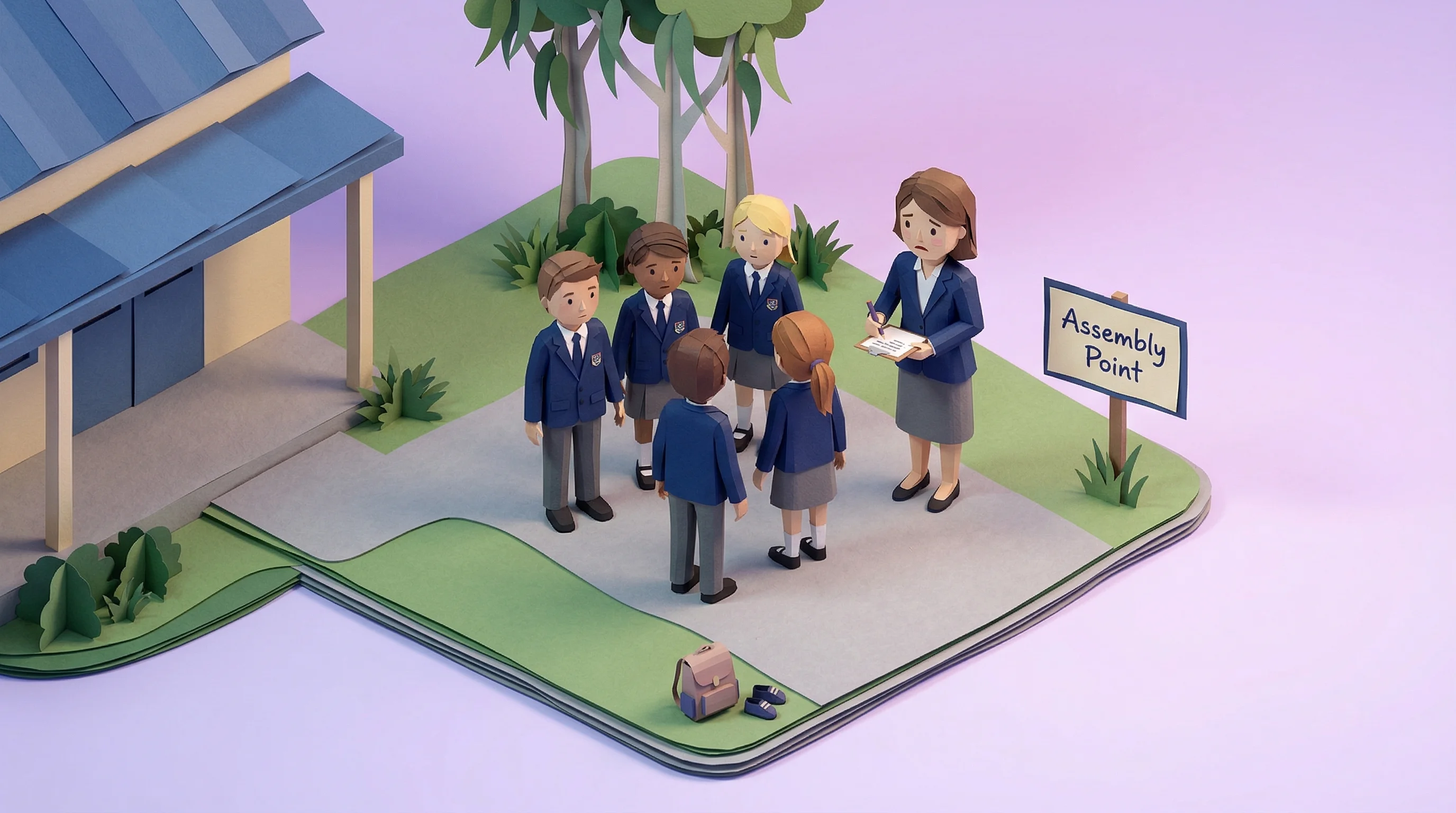
The investigation problem nobody talks about
Incident investigation can take significant deputy-principal time. When something happens at school — vandalism, bullying, vaping or property loss — the school needs to establish what occurred, who may have relevant information and what fair process should follow.
The challenge is often that records are scattered or incomplete. A teacher recalls two passes during Period 4, a paper sheet has no return times and the front office has no matching visit record. The wider investigation still needs to establish the facts fairly.
Without a shared record, a simple question — "Who had a recorded pass to B-block bathroom between 11:15 and 11:45?" — may require staff to locate paper sheets, messages and recollections before the wider investigation can begin.
What a typical investigation looks like without data
Let us walk through a scenario. It is Tuesday morning, 9:40am. A science teacher reports that the bathroom near her block has been vandalised. Graffiti on the wall, a soap dispenser pulled off its mounting. She noticed it when she used the bathroom before Period 2, and is fairly sure it was not there when she left yesterday afternoon. She suspects it happened during her Period 1 lesson because two students asked to leave class and both took longer than expected to return.
The DP now begins the investigation. Here is what that typically involves:
- Walk to the science block to inspect and photograph the damage
- Return to the staffroom and ask the Period 5 teacher from yesterday whether they noticed anything
- Visit every classroom that shares the science block and ask teachers to check their sign-out sheets from Period 1 this morning and Periods 4-5 yesterday
- Collect whatever sign-out sheets exist — some have names and times, some have names only, some are blank, and one teacher says they do not use sign-out sheets
- Cross-reference the names against student timetables to confirm they were actually in those classes
- Interview the students whose names appear, attempting to establish a timeline
- Log the outcome in Compass, SEQTA, Sentral, or whichever administration system the school uses
- Follow up with year coordinators and, if necessary, contact parents
In this illustrative scenario, gathering the distributed records takes 45 minutes. That number is not a customer result or benchmark; schools should measure their own retrieval and review time.
The frustration is not the behaviour itself. It is the time spent chasing information that should have been captured automatically.
The same investigation with pass records
Now consider the same scenario in a school using Vero.
The science teacher reports the vandalism at 9:40am. The DP opens the movement dashboard, filters by location (science block bathroom) and time (yesterday Period 4 through to this morning Period 1), and runs the search.
The search returns an illustrative list of eight teacher-created passes to that recorded destination. Each entry includes the student, issuing teacher and associated times. Two pass windows overlap. The list does not show that any student entered the bathroom or caused the damage.
The DP now has a focused starting point to review alongside maintenance timing, staff observations and student accounts. A digital search may reduce retrieval time, but the school should measure that outcome in its own process.
This is not a marginal improvement. It is a fundamentally different way of working.
How pass records support common investigation types
Bathroom vandalism is one of the most frequent triggers for investigation, but it is far from the only one. Here is how digital pass records can add limited context to the incidents deputy principals deal with most often.
Vandalism
Without a shared record, vandalism investigations may rely on staff memory and paper sheets. With Vero, a DP can search for students who had recorded passes to the affected destination during the relevant window. That record is a starting point to review alongside staff observations and student accounts; it does not prove responsibility or guarantee a reduction in bathroom vandalism.
Bullying and confrontation
Incidents reported outside the classroom can be difficult to investigate when there is no direct witness. Pass records cannot tell you what happened or where a student physically was. They can show overlapping teacher-created entries and whether Smart Separation displayed an advisory, which may be relevant context for the wider review.
Vaping and smoking
Where a school is addressing vaping in bathrooms, authorised staff can search for passes whose selected destination and time window may be relevant. Neither the pass nor a sensor alert proves who entered the bathroom or used a vape.
Theft and property damage
When property is reported missing, a pass record may add time context to a wider review. It does not show access to the room or justify treating students with overlapping passes as suspects.
Missing students and welfare checks
When a student does not return from a bathroom break, the first question is: when was the pass created and has a return been recorded? Without a consistent record, the teacher may not raise the question promptly. With a digital pass system, authorised staff can review the open record, recorded duration and selected destination. The welfare check can follow the school's procedure; the record does not establish the student's physical location.
The evidence quality difference
Digital and paper records have different strengths and limitations. Consider the difference:
- Paper sign-out sheet: A name (sometimes illegible), a destination (sometimes blank), a departure time (often rounded to the nearest five minutes), no return time. No verification that the teacher actually saw the student leave. No record if the student went somewhere other than their stated destination.
- Digital pass record: Student name, teacher who issued the pass, exact departure time, intended destination, return time, total duration, and a flag if the pass exceeded the expected time. Every record is timestamped to the second and tied to a specific teacher's account.
A timestamped record can add specificity to an authorised process, but its meaning remains limited to what the record contains. The school decides what evidence is appropriate under its own policy and applicable requirements.
It also matters for fairness. Present the record accurately: “A teacher-created pass to this destination was open for eleven minutes.” Do not say the data proves the student was physically in the area. Invite the student's account and review all relevant evidence under the school's process.
Timestamped digital records can support a fairer process only when their limits are clear and students have a genuine opportunity to provide context.
From isolated incidents to pattern review
Historical records may help leaders identify when recorded pass volume is concentrated by period or selected destination. They do not predict or prevent incidents.
Here is what that looks like in practice:
- Recorded-destination review. Where incident reports and pass volume cluster around the same destination or period, the school can decide whether supervision, facilities or routines need review.
- High pass-volume review. A student with many passes may have a medical, disability, learning, timetable, wellbeing or behavioural context. Begin with known adjustments and a conversation, not a label such as “frequent flyer”.
- Separation warning review. Smart Separation can warn a teacher when a named group member has an active pass. The teacher may wait or override with a logged reason; the warning does not guarantee separation.
- Time-of-day analysis. Some incidents cluster around transitions — the first ten minutes of Period 1, immediately after recess, the last period on Fridays. Pass-record volume can help the school ask whether supervision or support processes need review.
A short, regular review may help a school target attention, but it does not guarantee less investigation time or fewer incidents. Measure both against the school's own baseline.
What this means for the DP's workload
Deputy principals in Australian secondary schools carry an extraordinary workload. Behaviour management, welfare coordination, timetabling, parent communication, staff support, yard duty, and a dozen other responsibilities compete for a finite number of hours. Investigation is the task that most often eats into the others — because it is unpredictable, time-sensitive, and cannot be delegated.
Searchable records may reduce time spent locating paper sheets and messages. The size of that benefit depends on adoption, record quality and the school's investigation process.
Any time saved can return to student, teacher and wellbeing support. A one-term pilot should measure retrieval and investigation effort rather than assume a standard saving.
The shift from reactive to proactive is not a philosophical ideal. It is a practical outcome of having the right data at the right time. For deputy principals carrying the front-line burden of student behaviour in Australian schools, that shift changes everything.
See how Vero gives authorised staff a searchable, timestamped starting point for an investigation.
Book a walkthrough